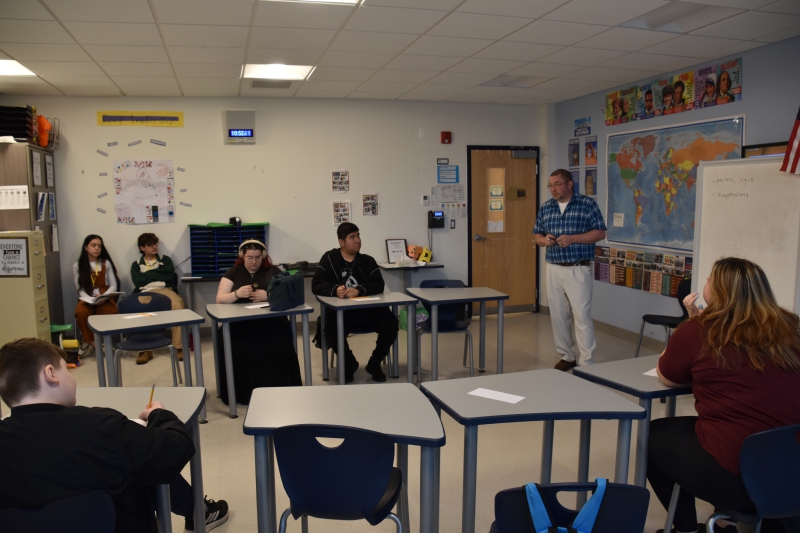
 This year, Resilience Academy students and staff dove into restorative justice with classroom sessions with help from a professional in the field. Restorative justice brings together individuals impacted by a conflict in order to understand the incident and identify ways to move forward and can become a transformative collective experience of healing through deepened connection and understanding.
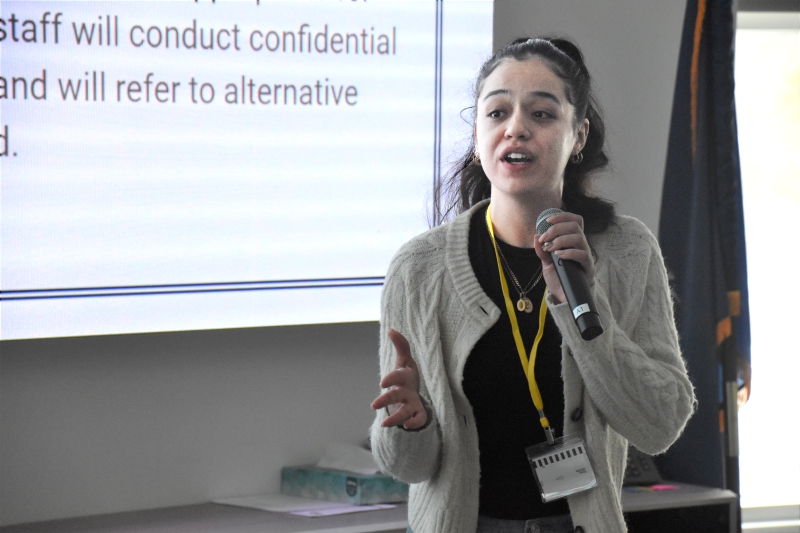
Paula Rodriguez, Director of Restorative Programs at the Mediation Center of Dutchess County, has been working with students since mid-winter on Tuesdays. She was first introduced to students during an assembly in which she explained how restorative justice is not a replacement for therapy and is voluntary, adding that students must navigate the journey they will take, as they are the experts in their own lives.
“I only go as far as you’re willing to go in your journey,” she said, explaining that she helps students figure out the best solution and resources for them. “You’re not just here to help a conflict, but you’re actually building a community, building tools and skills that you can take outside in life.”
When Principal Kiesha Tillman asked for examples of how restorative justice can be used in situations where no harm occurs, Rodriguez recalled when it was used in one school on twin students who needed to be separated during the day.
“They’ve been together all day and they had to come up with a plan so that they could have space and time apart because they’re like ‘I’m with him all the time,’” Rodriguez recalled. Another example centered around helping a group, “be creative so that they can actually have conversations with adults that are meaningful, not just conversations and curriculum that’s forced upon them.”
Circles where restorative justice is practiced can also be a helpful tool as Tillman noted that they do not always have to be used to address a conflict.
“It could be you’re just having a conversation about academics … maybe the circle is about a misunderstanding,” Tillman said, explaining that Rodriguez will support sitting in circles.
During one of the sessions, Teacher Daniel Lynch showed his students a video of restorative justice being practiced and asked them to jot down three observations. Lynch highlighted that the circles are a safe place to discuss matters. “Even without bullying, giving yourself out there to people can be intimidating,” Lynch said. “What happens here, stays here.”
Senior Alexandra Varble is part of Student Government, which initially proposed an idea to bring restorative justice to RA, and believes it can help students improve communications, build meaningful relationships and understand the gravity of what they do every day. She described it as a chance for students to resolve issues by delving into why they acted out originally.
“I understand its significance and I do think it could be beneficial for the school,” Varble said. “Everyone is going through something … it’s something this school needs.”