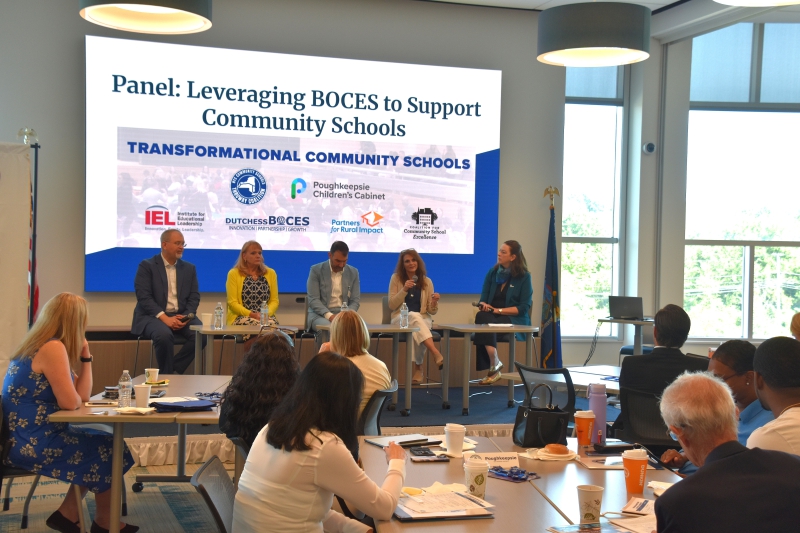
 Educators from Dutchess BOCES’ component school districts gathered this month to brainstorm and develop opportunities to meet students’ needs through a Community Schools model.
Community Schools provide services and support that fit a neighborhood’s needs. Assistant Superintendent of Educational Services Denise Dzikowski noted how the New York State Community Schools Thruway Coalition’s goal is to have locations along the Thruway that are interconnected so all state municipalities have resources available. This model is more cost effective for districts as there are various resources available and community agencies to partner with. “Amenia, for example, doesn’t have some of the resources that are available in downtown Poughkeepsie … However, the students in Amenia may have very similar needs, so how can we, as a BOCES, become the hub to create ways and opportunities for the students of Amenia to get those needs met?” Dzikowski said. “Partnering with agencies, such as the Poughkeepsie Children’s Cabinet, allows this to grow.”
The Transformational Community Schools Community Gathering, co-sponsored by the Poughkeepsie Children’s Cabinet, took place at the BOCES Conference Center Aug. 13 and 14 and featured Dr. Jay Roscup, who was instrumental in establishing the concept of Community Schools in Wayne County. He noted that BOCES locations and component districts need to think from a county perspective when making decisions. He added that when people work together to help students, they must all be on the same page. “We have got to create a county mechanism that bridges school and every other resource in New York State, or we are going to continue to have systematic failures that impact the ability of children to have hope-filled lives,” Roscup said. “This is a way to scale our collaboration and help young people feel the collaboration that we’ve spent 15 years building in a real way in their lives.”
John Orcutt, Arlington Central School District’s Superintendent of Curriculum and Instruction, appreciated that the conference clarified what the Community Schools model looks like and how it evolved, adding that Arlington’s next steps are to continue the conversation and roll it out slowly, but effectively. “This can’t just be ‘Here’s what Community Schools are, now go do it,’ it needs to be here’s what they are now, what are we doing next,” Orcutt said. “We’re excited to begin to engage in the conversation within the county.”
First Day Presentations
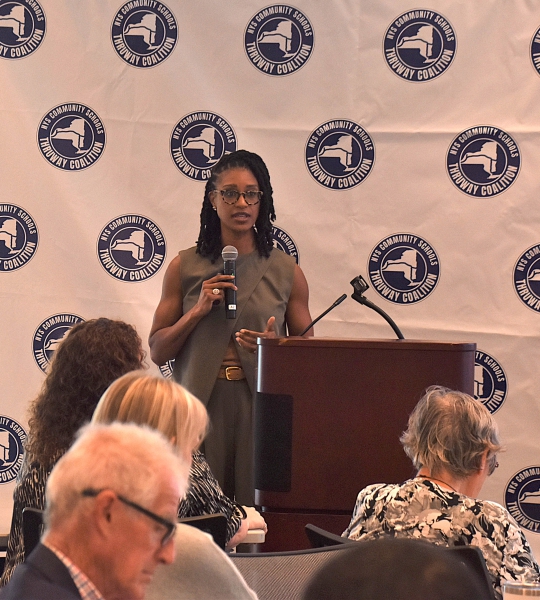 The keynote speaker was Dr. Ashley Cross, Founding Executive Director of HOPE585, a nonprofit dedicated to strengthening children and families through hope-centered and community-driven solutions. Students feel safer and more valued when trusted adults regularly connect with them to share what is important to them and to set goals, with Cross adding that having just one of these adults in their lives significantly changes outcomes. “Imagine if they have three or four or five … We need to surround our youth with hope and positive role models,” Cross said. “When young people feel like they belong, they begin to develop confidence and emotional security, it increases their agency, and youth need to experience belonging in and outside of their homes and their schools.”
Rob Watson, Executive Director of The EdRedesign Lab at Harvard Graduate School of Education and a Poughkeepsie High School graduate, said that Community Schools can be successful when people from varied institutions come together to generate plans that help all students succeed and bring them to school and government leaders to make them reality. “The communities that are doing this best have been able to create that bridge between the front lines and the systems coming together in conversation and each bringing their senses to bear to move the needle,” Watson said. “Relationships matter, they should embolden us as practitioners in this room, to think about how we might deepen relational supports in all the different types of work we do.”
Leveraging grants, programs and services
Dzikowski and Assistant Superintendent for Curriculum and Instructional Services Rebecca Green sat on a panel discussion about how BOCES can leverage grants, programs and cooperative services to enhance Community Schools. Green recalled attending a conference where she was part of a Community Schools Resource group and realized there were resources for students she was not aware of, and that collaboration was key. “As Denise and I continued to build partnerships with agencies around the county, it became apparent there were things we were not tapping into that would support students from different angles, not just using funding that came through a budget or only came through CoSers [approved cooperative agreements],” Green said. “It became more and more apparent that we’re better together.”
Dzikowski shared that mental health and socioeconomic disparity are the top emerging needs for children and that BOCES provides mental health services to students who attend its programs and specialized services to those in its component school districts. These services are requested through CoSers, many of which generate aid for districts in the following budget cycle. She added that patience is a virtue when it comes to helping students. “It’s not something you can take on all at once and that’s hard, because all of us in our hearts, want to fix everything for every child,” Dzikowski said. “We have to start smaller and go slower in order to do it well.”